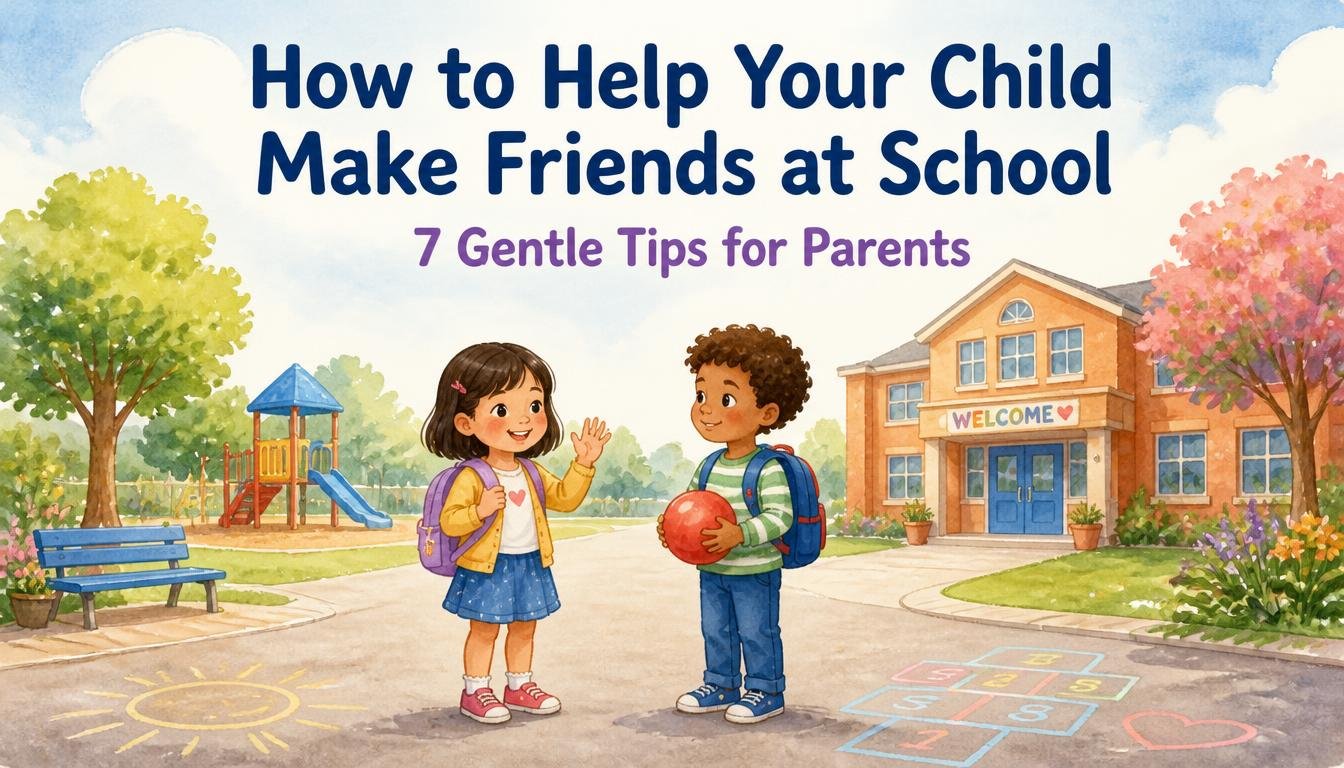
How to Help Your Child Make Friends at School: 7 Gentle Tips for Parents
Making friends at school doesn’t come easily to every child, and few things gnaw at a parent’s mind as much as wondering whether their child has someone to sit with at lunch. Some kids dive right in, while others hang back, unsure how to start a conversation with someone new. If your child is struggling, you are not alone, and there is plenty you can do to help without taking over the process.
In this guide you will learn why some children find it harder than others to make friends at school, what to look out for, and practical, gentle ways to help your child build real, meaningful friendships—including how the right storybook can really help.
Why Making Friends at School Doesn’t Come Easily for Every Child
It’s tempting to think that making friends is just a matter of personality, that some kids are “social” and some are not. But there’s usually something going on underneath.
Social skills develop at different rates. Just like walking or talking, the ability to initiate conversation, read social cues, and navigate group dynamics develops on its own timeline for every child. A child who seems behind socially at five may catch up entirely by seven or eight.
New environments reset the social clock. Even an outgoing child can struggle at the start of a new school year, a new classroom, or after switching schools, simply because the established social groups they once knew are suddenly unfamiliar again.
Shyness and introversion aren’t the same as social struggle. Some kids are naturally more reserved and genuinely prefer smaller, quieter friendships over big social circles. That’s a personality trait, not a problem to fix, and it’s worth distinguishing from a child who wants more friends but doesn’t know how to make them.
Anxiety can get in the way before a child even tries. For some kids, the fear of rejection or saying the “wrong” thing is enough to stop them from approaching other kids at all, even when they genuinely want to connect.
Kids often don’t have the script yet. Approaching a stranger, even a kid their own age, and starting a conversation is a skill, not an instinct. Many children simply haven’t been taught the basic, repeatable steps for how to do it.
Signs Your Child Might Be Struggling to Make Friends
Kids don’t always say directly that they’re having a hard time socially. A few signs worth paying attention to:
Reluctance or dread of school, particularly of unstructured times such as recess or lunch. He comes home and doesn’t mention any peers, even after weeks at a new school or in a new class. Always chooses to play alone when other kids are around and available. Physical complaints, like stomachaches, that often appear right before school. Comments that indicate self-doubt, such as “nobody wants to play with me” or “I don’t know what to say.”
None of these signs are a guarantee something is wrong, but together, or if they persist, they’re worth a closer, gentler conversation.
Practical Ways to Help Your Child Make Friends at School
1. Teach Simple, Repeatable Conversation Starters
Give your child some simple, low-stakes lines to practice and reuse: “Can I play too? Your [backpack/shoes/drawing] is cool. Where did you get it? ” What game are you playing? ” A script removes much of the guesswork that keeps anxious children from talking to others.
2. Practice Through Role-Play at Home
ternate between the ‘new kid’ and the ‘friend’ in a casual home setting. It allows your child to try out conversation starters and responses before they have to use them in a real, higher-stakes situation.
3. Arrange Small, Low-Pressure Playdates
A one-on-one playdate with a single classmate is often far less intimidating than navigating a large group at school. These smaller settings give friendships room to develop naturally, away from the social pressure of a busy classroom.
4. Identify a Shared Interest as a Starting Point
Help your child notice what they have in common with specific classmates, a favorite show, a sport, a hobby. Shared interests are often the easiest, most natural bridge into a new friendship.
5. Talk to the Teacher
Teachers often have valuable insight into classroom social dynamics and can sometimes make small, supportive adjustments, like seating arrangements or partner assignments, that create natural opportunities for connection.
6. Focus on Quality Over Quantity
Remind your child, and yourself, that one or two solid friendships matter far more than being popular with everyone. Shifting the goal from “be liked by all the kids” to “find one or two good friends” takes a lot of pressure off.
7. Use Stories to Model the Process
Reading a story about a character navigating the exact same challenge, feeling nervous, not knowing what to say, and eventually finding a friend gives kids a low-stakes way to see the process play out before attempting it themselves.
How Storybooks Help With Making Friends at School
Books about making friends work well because they externalize the problem. Rather than a child feeling like they’re the only one who struggles with this, watching a character go through the same nervousness and uncertainty normalizes the experience.
A good friendship-making story typically shows a character who feels genuinely unsure, maybe even scared, about approaching someone new, followed by a small, believable success, not an instant, perfect friendship, but a first conversation, a shared laugh, and an invitation to play. This mirrors the actual, gradual process of making friends far more realistically than a story where two characters are instantly inseparable.
Reading these stories together also opens a natural door for conversation. After finishing a book, asking “What do you think helped them become friends?” or “Have you ever felt like that character?” invites your child to reflect without feeling like they’re being interrogated about their own social struggles directly.
What to Avoid, Even With Good Intentions
Avoid forcing friendships. Pushing your child toward a specific classmate because they seem nice or because you’re friendly with their parent rarely works and can add pressure rather than ease it.
Avoid comparing your child to more social siblings or peers. “Your sister never had trouble making friends” tends to make an already anxious child feel worse, not more motivated.
Avoid solving every social problem for them. While stepping in sometimes is appropriate, especially with bullying, giving your child room to navigate small social challenges themselves builds real confidence over time.
Avoid framing friendship-making as a performance to report on. Constantly asking “did you make any friends today?” can add pressure and turn something that should feel natural into one more thing to succeed or fail at.
A Few Questions Parents Often Ask
My child has one close friend but struggles to expand their social circle. Should I be concerned?
Not necessarily. One solid, reciprocal friendship is genuinely enough for many kids, and some children simply prefer smaller social circles throughout their lives. The key question is whether your child seems content, not whether they match some external idea of how many friends they “should” have.
How long does it typically take for a child to make friends after starting a new school? This varies widely, but most kids begin forming at least casual friendships within the first month or two. If significant distress continues well beyond that, it may be worth checking in with the teacher or a school counselor.
My child says they want friends but doesn’t seem to try. What’s going on?
This often comes down to not knowing how to start, rather than not wanting to. Teaching specific, practiced conversation starters, as mentioned earlier, frequently helps more than general encouragement to “just go talk to someone.”
Should I worry if my child prefers playing alone most of the time?
Not automatically. Some kids are naturally more independent and recharge through solo play, which isn’t inherently a problem. The distinction to watch for is whether your child seems happy with that choice or seems to want connection but doesn’t know how to get there.
Where to Find Free Books About Making Friends
A growing collection of free, warmly illustrated picture books makes it easy to find stories that mirror exactly what your child might be going through, nervousness about a new classroom, uncertainty about approaching someone new, or the slow, believable process of forming a first real friendship.
Having a few of these stories on hand means you’re ready for a gentle, low-pressure conversation whenever your child seems to need it, without having to search for the right book in the moment.
How Parents Can Model Friendship-Building Too
Kids pick up on far more than direct instruction when it comes to social behavior, they watch how the adults around them handle meeting new people, navigating small awkward moments, and building relationships over time. Letting your child see you strike up a brief, friendly conversation with another parent at pickup, or talk through a minor social hiccup out loud (“I wasn’t sure what to say at first, but then I just asked her about her dog”), quietly models the exact skills you’re hoping they’ll develop themselves.
This doesn’t need to be a deliberate lesson. Simply narrating your own small social moments in an easygoing way, without turning it into an obvious teaching opportunity, often sinks in more naturally than direct advice ever does. Kids learn a lot simply by watching you. The Kids Mental Health Foundation suggests letting your child see you laugh and talk with your own friends, and explaining how those friendships started and grew. Their guide on helping kids build friendships also shares simple ways to coach social skills at home, which can make making friends at school feel much less scary.
Final Thoughts
Making friends at school is a skill, not a fixed trait, and most kids get better at it with a little guidance, practice, and patience. Simple conversation starters, low-pressure playdates, and stories that model the process can make a real difference, often more than any single piece of advice delivered in the moment.
If your child is navigating this right now, start small. Read a story together about a character facing the same uncertainty, practice a conversation starter or two at home, and keep the pressure low. Most kids find their footing socially faster than the anxious mornings ever suggest they will.
Looking for gentle stories to help your child navigate friendship and belonging? Browse our full Kids Library for free picture books about making friends, courage, and big feelings.



One Comment