Moral Stories for Kids: 6 Best Short Tales With Lessons
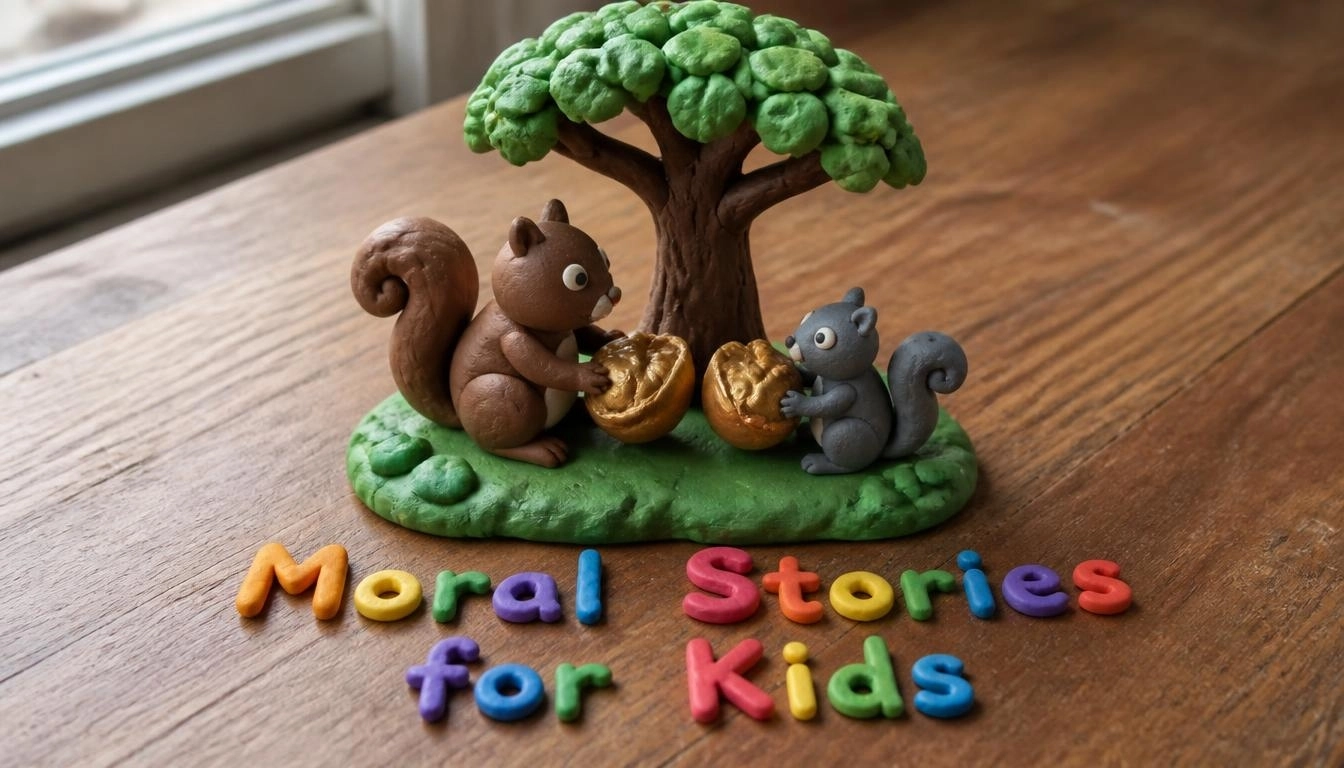
There’s a quiet kind of power in moral stories for kids. A five-year-old is likely to just bounce right over a lecture on sharing. But a story of two squirrels and one acorn? That’s stuck. The kids feel what the characters feel and the lesson comes without anyone raising their voice.
Here are 6 moral stories for kids that are so short you can read them in two minutes. Each story ends with a clear moral and a question for discussion together. After the stories, you’ll find simple ways to discuss values with your child, plus common mistakes to avoid.
Why Moral Stories for Kids Work

Children learn values mostly by watching the people around them. Stories add something extra: a safe way to see how choices turn out.
- They show, not tell. A character who is selfish and feels lonely teaches more than “don’t be selfish.”
- They give children words for big ideas. Honesty, patience, and kindness become easier to talk about.
- They invite conversation. A story is a gentle way to bring up something difficult.
- They make lessons memorable. Children remember stories far longer than rules.
Stories work best alongside your own example. If your child sees you sharing and being patient, the stories only make it stronger.
6 Original Moral Stories for Kids to Read Aloud
1. The Last Acorn

Ages 3 to 6 · Moral: sharing · Reading time: 2 minutes
Winter was coming, and Hazel the squirrel had found one big, golden acorn. She hugged it tight. “Mine,” she whispered.
Down the branch sat her friend Rusty. His acorn pile had been washed away by the rain. He shivered and rubbed his tummy.
Hazel looked at her acorn. She looked at Rusty. Her tummy rumbled too.
“If I share,” she thought, “I’ll have less.”
But Rusty’s ears had drooped like wilted leaves. Hazel took a deep breath, cracked the acorn in half, and held out the bigger piece.
“Here,” she said. “Let’s share.”
Rusty’s eyes lit up. They sat side by side and munched together, the cold wind forgotten.
When spring came and the trees filled with new acorns, Rusty brought Hazel the biggest one he could find.
Moral: Sharing makes happiness bigger.
Talk about it: Is it easy or hard to share something you love? How did Hazel feel at the end?
2. The Ants and the Big Leaf
Ages 3 to 6 · Moral: teamwork · Reading time: 2 minutes
One morning, a very big leaf fell near the anthill. It was green and crisp and perfect for building a roof.
“I’ll carry it!” said Ant Benny. He pushed and pulled, but the leaf didn’t move an inch.
“I’ll do it,” said Ant Tia. She tugged and tugged and tumbled flat on her back.
The leaf stayed where it was.
Little Ant Max had been watching quietly. “What if we all push together?” he asked.
So Benny took one side. Tia took another. Max and ten more ants lined up in a row. “One, two, three, push!”
The leaf wobbled. Then it began to slide. Inch by inch, the ants carried it all the way home, singing as they went.
By evening, the anthill had a fine green roof, and not one ant felt tired.
Moral: Together, we can carry more than we can alone.
Talk about it: What happened when the ants tried alone? What changed when they worked together?
3. The Seed That Wouldn’t Hurry
Ages 4 to 7 · Moral: patience · Reading time: 2 minutes
Mina planted a sunflower seed in a little pot and pressed the soil down with her thumb. “Grow!” she said.
The next morning, nothing had happened. So Mina dug up the seed to check. It was still a seed. She tucked it back into the soil.
The next day, she dug it up again. Still a seed.
Grandma noticed her muddy fingers. “What are you doing, Mina?”
“I’m checking if it’s growing. It’s too slow!”
Grandma smiled. “Seeds grow in the dark first. They grow roots before they grow flowers. All the busy work happens where we can’t see it.”
Mina frowned. “So I should wait?”
“Water it, give it sunlight, and let it be.”
Mina tried. Each day she watered the pot and left the soil alone. After ten long days, a tiny green shoot poked out. After many weeks, a tall yellow sunflower smiled at the window.
Moral: Good things take time.
Talk about it: What is something you’re waiting for? What can you do while you wait?
4. Kai, the Fastest Fish

Ages 5 to 8 · Moral: kindness over winning · Reading time: 2 minutes
Kai was the fastest fish in the whole reef. He won every race, and he never let anyone forget it.
“Too slow!” he’d call to the others. “Better luck next time!”
One day, the reef held its big race. Kai zoomed ahead, far in front of everyone. The finish line was in sight.
Then he heard a tiny cry. “Help!”
A little fish named Dot was stuck in a tangle of seaweed. She wiggled and twisted, but she couldn’t get free.
Kai paused. If he stopped, he would lose. “Someone else will help,” he muttered.
But nobody else was near. Dot’s eyes were wide with fear.
Kai sighed, turned around, and gently untied the seaweed, one strand at a time. Dot gave him a big, bubbly smile.
By the time they swam to the finish line, Kai was last. But strangely, he didn’t feel like a loser at all. The whole reef cheered for him.
Moral: Being fast is good, but being kind is better.
Talk about it: Why did Kai feel happy even though he lost? What would you have done?
5. Grandpa’s Thank-You Jar

Ages 5 to 8 · Moral: gratitude · Reading time: 2 minutes
“It’s boring here,” Sami sighed, flopping onto the sofa. “There’s nothing to do.”
Grandpa looked up from his tea. “Come here. I want to show you something.”
On the shelf sat a big glass jar full of folded paper notes. “Every evening,” said Grandpa, “I write one thing I’m thankful for and drop it in.”
Sami pulled out a note. Warm socks. Another. Rain on the window. Another. Sami’s laugh.
Sami blinked. “You wrote about me?”
“Many times,” Grandpa said, smiling.
That night, Sami found a pen and a scrap of paper. Grandpa’s tea, he wrote, and dropped it into a small jar of his own.
The next night, he wrote another. By the end of the week, he noticed things he’d never noticed before: the smell of toast, the way the cat purred, and a funny cloud shaped like a rabbit.
The days didn’t feel boring anymore.
Moral: Being thankful turns ordinary days into gifts.
Talk about it: What are three things you’re thankful for today?
6. The Blue Marble
Ages 5 to 8 · Moral: kindness and belonging · Reading time: 2 minutes
At recess, Leo stood by the fence. He was new, and he didn’t know anyone. Everyone else was busy playing.
Ava saw him from across the playground. She had a small blue marble in her pocket, the one she’d been saving for something special.
She walked over. “Do you like marbles?”
Leo’s face brightened. “I have a red one at home.”
“Want to play?” Ava drew a circle in the dirt and held out the blue marble. “You can go first.”
Leo flicked it. It rolled in a perfect line. “Nice shot!” Ava cheered.
Two other kids drifted over to watch. Then three more. Soon a whole crowd was kneeling in the dirt, laughing and cheering.
When the bell rang, Leo grinned. “Thanks for asking me to play.”
Ava shrugged. “That’s what friends do.”
Moral: A small kindness can help someone feel they belong.
Talk about it: How can you help someone who feels left out?
How to Talk About the Moral Without Lecturing

The story does most of the work. Your job is to leave space for your child to think.
- Read the story first. Don’t announce the moral at the start.
- Ask before you tell. “What do you think the story is about?” often leads to a surprising answer.
- Connect it to real life. “Has that ever happened to you?” makes the lesson personal.
- Keep it short. A minute of talking is enough. Long talks can feel like a lecture.
- Let the moral stand. If your child says it in their own words, that’s better than your version.
- Live it. Children copy what we do, so let them see you sharing, waiting, and saying thank you.
Moral Stories for Kids by Age
| Age | Good themes and story style |
| 2 to 3 years | Sharing, being kind, saying sorry. Short stories with animals and repeated lines |
| 4 to 5 years | Patience, helping, teamwork. Simple plots with a clear problem |
| 6 to 8 years | Honesty, gratitude, fairness, courage. Stories with a small twist |
| 9 to 12 years | Responsibility, integrity, empathy. Longer stories with harder choices |
If a story is too simple, add a harder question. If it’s too complex, simplify it as you read.
Common Mistakes When Reading Moral Stories for Kids
- Over-explaining the lesson. If you explain every detail, the magic disappears.
- Forcing a moral every time. Sometimes a story is just for fun, and that’s okay.
- Using stories to shame. “Be like the good character” can make a child feel bad. Keep the tone warm.
- Making the lesson too obvious. Children are smart. Let them find it.
- Reading only when there’s a problem. Stories work best as a regular habit, not just after something goes wrong.
Where to Find More Moral Stories for Kids
Once your child wants “just one more,” try these:
- Our short stories for kids include a story about honesty and one about trying again.
- For stories about being kind, see our books about kindness for kids.
- For bravery, try our free courage books for kids.
- For working together, read children’s stories about teamwork.
- If your child struggles with big feelings, see our emotions book for kids.
- Browse our full free kids books library, or read about free children’s books online.
For more reading ideas, Reading Rockets has simple tips for parents.
Final Thoughts
Moral stories for kids don’t need to be heavy. A small story about an acorn, a seed, or a blue marble can plant a big idea. Pick one tonight, read it slowly, and ask one gentle question at the end.
Values grow slowly, one story and one conversation at a time. And the best part is that you’ll often find the stories teach us, too.
Frequently Asked Questions
What are good moral stories for kids?
Good moral stories for kids have a simple plot, a character who faces a choice, and a clear but gentle lesson. Animals and everyday situations work especially well.
How long should moral stories for kids be?
For young children, one to three minutes of reading aloud is a good length. Older children can enjoy stories of five to ten minutes.
What age is best for moral stories?
Children can enjoy them from around age 2 or 3. Choose simple themes like sharing and kindness for little ones, and more complex ones like honesty and responsibility for older children.
How do I teach my child a moral from a story?
Ask what they think the story is about, link it to a real situation, and keep the talk short. Letting your child find the lesson works better than explaining it.
Do moral stories for kids really work?
Stories can help children understand values and talk about them, but they work best alongside the example you set at home.
Should every story have a moral?
No. Some stories are simply for fun, and that’s perfectly fine. Moral stories are one type among many.