The Ultimate Free Reading List for 1 Year Olds
If you’ve ever handed a book to a one-year-old and watched them try to eat it, flip through ten pages in five seconds, or close it mid-sentence, welcome to the club. Reading to a one-year-old doesn’t look like reading at all, not the way we think of reading. No quiet cuddling through the whole story, front to back. No dramatic pauses for effect. It’s wild, it’s short, and frankly, if you get over expecting it to look like anything other than what it is, it’s kind of magical.
The good news? You don’t need a whole shelf of expensive hardcovers to get in the habit. Some of the best books for 1 year olds are totally free, and in this guide we’re breaking down exactly what to look for, why it matters this early, and where to find free books for 1 year olds that your toddler will actually want to touch, chew, and (eventually) sit still for.
Why Reading at Age One Actually Matters
Reading is so often seen as “not really beginning” until a child can talk, have an understanding of a plot, and sit through an entire story. But the truth is, a baby’s brain is doing a tremendous amount of work in that first year—and books have more to do with it than most people think.
Even if your child isn’t stringing many words together yet, at age one they are soaking up language at an amazing rate. When you read aloud, touch a picture, or name something on a page, you are laying the foundation for vocabulary that will pop up months or even years down the road. Researching early literacy always points to one simple fact: Kids who are read to regularly before age two tend to develop stronger language skills sooner than those who do not. Organizations like Reading Rockets have written extensively about the link between early reading and stronger vocabulary development.
But the story is not just vocabulary. At this age reading together also encourages the following:
- Attention and focus—even small bursts of “look here” build the muscle for longer attention spans down the road
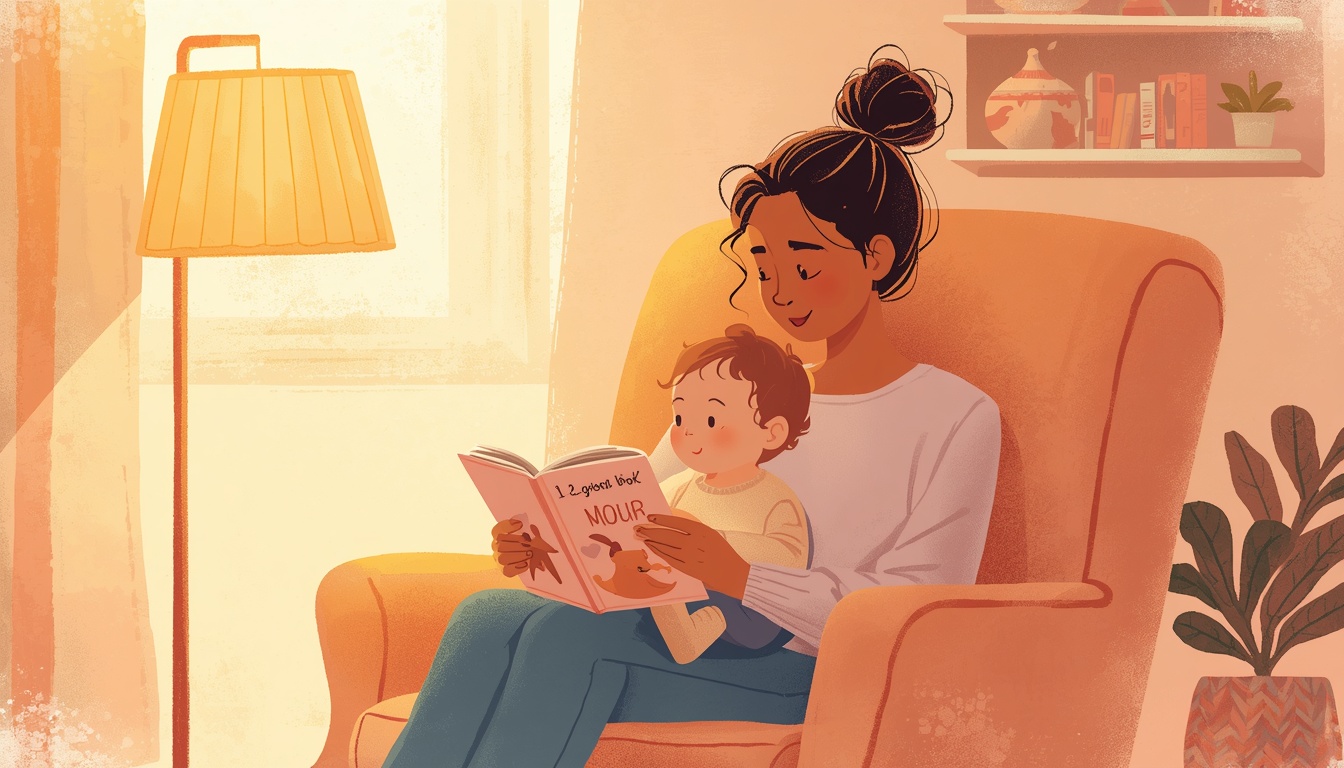
- Bonding and security—the physical proximity of reading together, the same voice, and the same lap become a ritual of comfort
- Fine motor skills—turning through thick board book pages, poking at textures, and lifting flaps.
- Emotional regulation—A predictable bedtime story routine creates a sense of safety and security in toddlers
None of this requires a “real” reading session. Even three minutes of pointing to pictures and saying what you see is enough. That’s the beauty of reading at this age: there’s no pressure, and there’s no wrong way to do it.
What Makes a Book “Right” for a 1 Year Old
Not all children’s books are for this age group, and that’s fine. A one-year-old is very different from a four-year-old. This is what actually works at this stage.
simple, strong pictures rather than busy illustrations. Children learn to recognize shapes and objects at this age. 1 page. Too much detail. Find books with one simple picture on each page—one dog, one ball, one smiling face.
Very few words, or none at all. A one-year-old can’t understand a long sentence. The best books for this age may have a single word on a page (“dog,” “ball,” “up,” “more”) or no text at all, so you can make up your own story as you go.
Sturdy pages that survive chewing and grabbing. That’s why we have picture books. At this age a book is as much a toy as a story, and it must survive being dropped, chewed, and sometimes used as a hammer.
Repetition and rhythm. Toddlers like to know what’s coming. A book where each page has the same phrase (“Where’s the bunny? There’s the bunny!”) helps them anticipate what’s coming, which is deeply satisfying for a developing brain.
Familiar, everyday themes. Animals, colors, family members, mealtimes, bedtime, and bath time. One-year-olds connect best with things they already recognize from their own world.
The Ultimate Free Reading List for 1 Year Olds
Now we come to the point. Here’s the ultimate list of free books for 1 year olds, broken down by category, so you can build a rotating collection without spending a dime.
1. First Words and Naming Books
These are basic picture books with one object, animal, or action on each page and one word on each page. These are great for pointing, naming, and repeating together. Find free books that use frequent words about animals, food, colors, and household items. These books are story time and vocabulary building.
2. Animal Sound Books
There is just something about the noises that animals make that one-year-olds simply cannot get enough of. With a collection of different farm animals along with the sounds they make, this picture book is ideal for a very basic and funny routine: pointing at the cow and making the “moo” noise.
3. Gentle Bedtime Stories
Starting a bedtime story ritual, even at one, pays off hugely down the line. Search for free bedtime picture books that feature gentle illustrations, soothing rhythms, and a predictable “Goodnight” pattern. You don’t have to complicate the story. In fact, at this age, the more simple and repetitive, the better—it’s the routine itself that matters most.
4. Rhyme and Song Books
Free picture books for kids There are classic rhymes that can be used as picture books. Children will love songs like “Itsy Bitsy Spider” because they are rhythmical, and this will help them to guess what comes next. They will even be able to “sing” the songs and yet not be able to say a word.
5. Imitation and Action Books
Books that get you to clap, wave, or copy simple actions make reading a physical, interactive experience rather than a passive one. This is exactly how toddlers learn at this age, through this type of imitation play, and adding a book makes reading time feel like a game.
6. Touch-and-Feel or Interactive Concept Books
If you can find free versions with different textures, flaps, or simple interactive bits, all the better. Anything that makes a one-year-old want to touch, poke, or pull will hold their attention much longer than plain text ever could.
How to Actually Use This List (Without It Becoming a Chore)
Free books are another thing. But actually building a habit around them is something else. A couple of honest tips for parents starting out.
Keep books somewhere your toddler can reach them. If books are hidden away on a high shelf, they’ll never be part of everyday life. A low basket or a face-out shelf with covers you can see works way better than a spine-out bookshelf that a toddler can barely see anyway.
Do not try to “finish” a book. Most reading sessions will be short and scattered. Your toddler may want to go back to their favorite page five times in a row and ignore the rest. That’s totally normal, and it still counts.
Incorporate into an existing routine. If you attach reading to something already happening every day, like immediately after a nap or immediately before bed, it’s much easier to keep up than if you try to create a new “reading time” from whole cloth.
Let them go first. If your toddler wants to hold the book upside down, chew on the corner, or flip three pages at a time, let them. The aim at this age is not understanding. “It’s building a positive, low-stakes relationship with books.
Rotate your free library. And these books are free, so why just limit yourself to two or three? By introducing new titles every week or so, you are giving your toddler a wider range of pictures, sounds, and words to take in.
Where to Find Free Books for 1 Year Olds
This is where parents often get lost; bookstores cost a lot of money, and library trips aren’t always feasible when you’ve got a toddler in tow, and not every home has a pile of used board books sitting around.
And that is just the kind of place where a free digital library can fit in. Illustrations of picture books that are instantly downloadable Beautifully illustrated, and there are no subscriptions, no waiting lists Nothing is paid for: Create your library, which will keep expanding according to your child’s age group. Be it bedtime stories, sounds of animals, or even first words in picture books.
A Simple Takeaway
You don’t need a perfectly curated bookshelf or a rigorous daily reading regime to raise a child who loves books. What you need is access, repetition, and a little patience as your one-year-old discovers that books are actually pretty fun.
Take small steps first. Pick one or two of the free books this week, read them in short bursts, let your toddler lead the way, and don’t worry about doing it “correctly.” At this age, every page you point to, every animal sound you make together, every bedtime story you settle into is quietly adding up to something bigger than it seems in the moment.
This list of free books for 1 year olds is meant to be a starting point, not a strict checklist. Want free beautifully illustrated picture books to start your own collection? Check out our full kids’ library for storybooks great for toddlers just like yours.