10 Creative Ways to Get Kids Excited About Their Family History
Family history for kids doesn’t have to feel like a boring lecture. Ask most kids about their family history and they’ll give you a shrug. It’s far away, it happened before they were born, and without anything to make it real and personal, it’s easy for it to remain a dull collection of names and dates that belongs to grown-ups. But family history, when done well, is actually one of the richest, most engaging things you can share with a child, full of stories, characters, and a real sense of “this is where I come from.”
The trick is to present it as if it’s a discovery rather than a history lesson. Here are ten fun, low-pressure ways to get your kids authentically excited about their roots, no dusty family tree chart required.
1. Turn Old Photos Into a Guessing Game
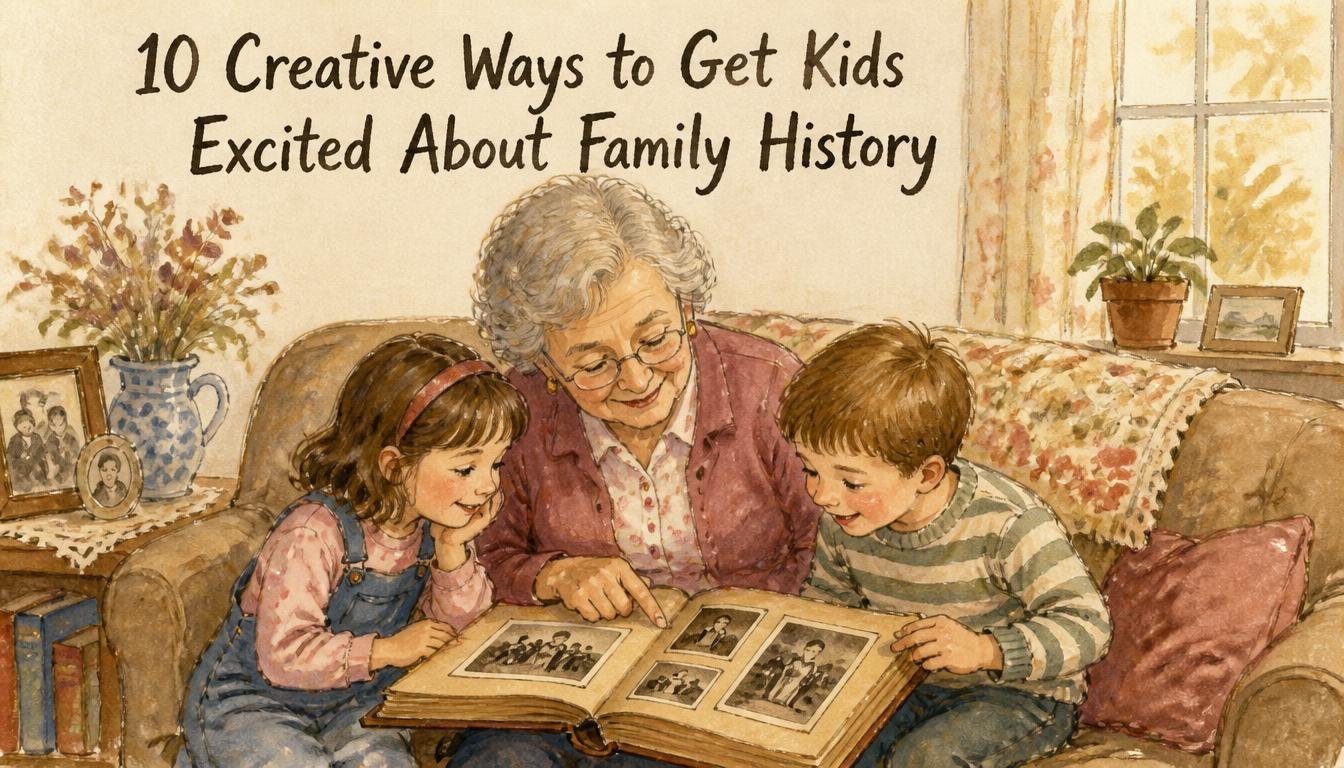
Make it a game rather than sit the child down and tell them who everyone is in an old photo album. Show them a photo and ask them to guess the age of the person in it. What do they think it is from ten years? What do they see in the clothes, the house, and the background?
This approach turns family history from a lecture into a puzzle kids really want to solve. When they have guessed, that’s your natural opening to tell the real story. Children are far more likely to remember the details when they have been involved with the mystery in the first place.
2. Tell Stories, Not Facts
Saying that “your great-grandfather immigrated in 1952” is very different from telling the story of why he left, what the journey was like, what he was nervous about, and what surprised him when he got there. Kids relate to the story, not data points.
And if you don’t know the whole story, that’s fine too. And even a partial story, with some imagination filling in the gaps (“we’re not totally sure, but the family always said…”) tends to connect better than a flat timeline of facts could.
3. Create a Family Map
Find a basic map of the world or a country and mark the places where different relatives lived, were born, or came from. Let your child add pins, stickers, or drawings to each place. It takes an abstract idea—”our family has roots in different places”—and makes it visual and concrete, something kids can actually see and explore.
For younger kids, this can be as simple as marking a few key spots. For older kids, it can turn into an ongoing project, adding new locations as they learn more or as new family stories come up.
4. Cook a Recipe From a Relative
Food is one of the most powerful sensory ways to connect children to family history. Even a simple recipe, cooking it together with a grandparent or great-grandparent, gives kids a hands-on experience connected directly to a real person and often a specific place or culture.
While you’re cooking, tell me what you know about the recipe’s context: where it originated, who used to make it, and what occasions it was served for. The taste and smell and story of it all tend to stick with kids much better than a name on a family tree.
5. Record an “Interview” With an Older Relative
Kids love to have a phone or tablet and feel like a real reporter. Ask them to “interview” a grandparent, older relative, or family friend with a few simple questions. What was your favorite game as a kid? What did you have when you were young that was different? What is a memory that makes you laugh?
This does double duty; it gives kids ownership over the process, and it often produces genuinely charming, unscripted answers that are treasured family recordings down the line.
6. Build a Simple, Visual Family Tree Together
Forget the formal, text-heavy family tree chart and make one that is really fun to make. Don’t just use names, use photos, have your child draw simple pictures of relatives they have never met, or use different colors for different branches of the family.
You don’t want historical accuracy but a visual hook for your child for the names they hear over and over at the family gathering so that “Aunt Carol” and “Great-Uncle Pete” begin to seem like real people with a place in the broader story, not just names that come up at holidays.
7. Connect Family History to Something They Already Love
If your child is obsessed with a particular hobby, sport, place, or era, check to see if there is some family connection to it, even a loose one. Did a great grandparent play the same sport? Did a relative live in a place your child always dreamed of visiting? Did an ancestor of yours have a job that connects to something your own child loves right now?
You don’t need deep links for them to work. Any connection, even a trivial, personal one (“your great-grandpa loved baseball too”) gives a child a personal reason to care about someone he never met.
8. Make a “Then and Now” Comparison
Kids love finding differences, and family history is full of them. Look at an old family photograph of a house, school, or neighborhood, and compare it with the way that same place looks today. Discuss how a day in your relative’s life may have been different than your child’s day.
This kind of comparison makes history real, not abstract, and helps kids see that “the past” wasn’t just black and white photos, it was people living real, different, everyday lives.
9. Turn Family Stories Into a Homemade Book
Kids love to see themselves and their families in a real book. Turn a special family story, a funny mistake, a memorable trip, or the meeting of two relatives into a simple homemade storybook with your child’s own illustrations.
This project does a lot at once: it solidifies the story by retelling it, it gives your child creative ownership of the presentation, and it creates something tangible for the family to return to for years to come. It also introduces the idea that family history is not just something that happened, it is something that can be told and retold as a story, just like any favorite picture book.
10. Celebrate a Family Tradition With Its Backstory
Many families have traditions, a certain holiday dish, a yearly gathering, and a particular saying, but they never explain where they came from. The next time a tradition comes up, take two extra minutes to tell where it originated. Why did this begin? Who was it? What does it mean to different members of the family?
This turns something that is a routine and sometimes even a grudging tradition (“why do we always have to do this?”) into something that has real meaning behind it. And that tends to make kids far more invested in keeping it going themselves someday.
Why Family History for Kids Actually Matters
There’s more than just fun involved in helping kids connect with their family history—there’s real developmental value.
It builds a sense of identity. It builds a sense of identity. When kids know where they come from, and not just their immediate day-to-day experience, they get a bigger picture of who they are. Child development experts at Zero to Three often point to this kind of identity-building as an important part of healthy emotional growth in young children.
It strengthens intergenerational bonds. Projects like interviews, recipes, and shared storytelling offer tangible points of connection between kids and older relatives, relationships that might otherwise feel distant or formal.
It introduces history in a personal, memorable way. When history is taught abstractly in school, kids have a hard time relating to it. Family history provides a personal entry point to make larger historical ideas, immigration, different ages, and cultural change real rather than theoretical.
It builds resilience through story. Learning that relatives had real challenges to face, that they moved to a new country, and that they had hard jobs and hard times, and these quiet examples of perseverance can be truly reassuring in their own tough moments.
A Few Tips for Making This Feel Natural, Not Forced
Making family history for kids feel natural rather than forced comes down to a few simple habits.
Make sessions short. Better than formal, scheduled “family history time” that can feel like homework, is a quick photo-guessing game in the car or a ten-minute chat over dinner.
Let curiosity be your compass. If your child asks a random question about a relative, follow that thread instead of rigidly following a planned project. Genuine curiosity is the best entry point you can get.
Don’t worry if you get it exactly right. Family stories change and get a little fuzzy over generations, and that’s part of the fun. The point is connection and interest, not a documented, footnoted history.
Periodically review projects. Making a family map, a homemade book, or a recorded interview isn’t a one and done activity. Adding to it from time to time keeps the project alive and gives the kids a feeling that it is growing along with them.
A Few Questions Parents Often Ask
Here are a few things parents often wonder about family history for kids.
My family doesn’t have many old photos or records. Can we still do this?
Definitely. Family history is not only about documents and photographs, it is also about stories, memories, and traditions handed down orally. Sometimes the spoken words of an older relative recorded on tape can hold as much richness as an old photo album.
What if some parts of our family history are complicated or hard to talk about? It’s okay to tell a story with age-appropriate details and tell the more complex details when your child is older. You don’t have to do it in one go. Family history is something you can add to over the years. It doesn’t have to be a single conversation you get perfectly the first time.
At what age should kids start learning about family history?
That age is not set in stone. Very young children like looking at pictures and hearing simple stories, and older children can be involved in more of the process themselves, such as doing interviews or helping to create a family tree. Activities are naturally scaled to the age and attention span of the child.
What if my child seems uninterested at first?
It’s normal, and it doesn’t mean that the effort was wasted. Interest may come slowly, but it is ignited by one point of interest, not the entire project. Sessions should be short and low pressure, which, as I mentioned earlier, works far better than dragging a reluctant child through a lengthy family history lesson.
Bringing It All Together
Family history doesn’t have to be a dusty binder or a complicated genealogy chart to be important to kids. With a little creativity, a bit of a guessing game here, a recipe there, a recorded interview, and a homemade storybook, it can become something that’s really engaging, something that your child feels like they are a part of, instead of something that happened to other people a long time ago. That’s really the heart of what makes family history for kids so worthwhile.
Choose one concept from this list and try it out this week. Notice what your child gravitates toward, whether it’s the storytelling, the visuals, or the hands-on cooking, and use that to guide your next steps. These small moments add up to something meaningful over time: a child who not only knows their family history, but feels connected to it.
Looking for more ways to spark meaningful conversations with your kids? Browse our full Kids Library for free storybooks about family, belonging, and connection.