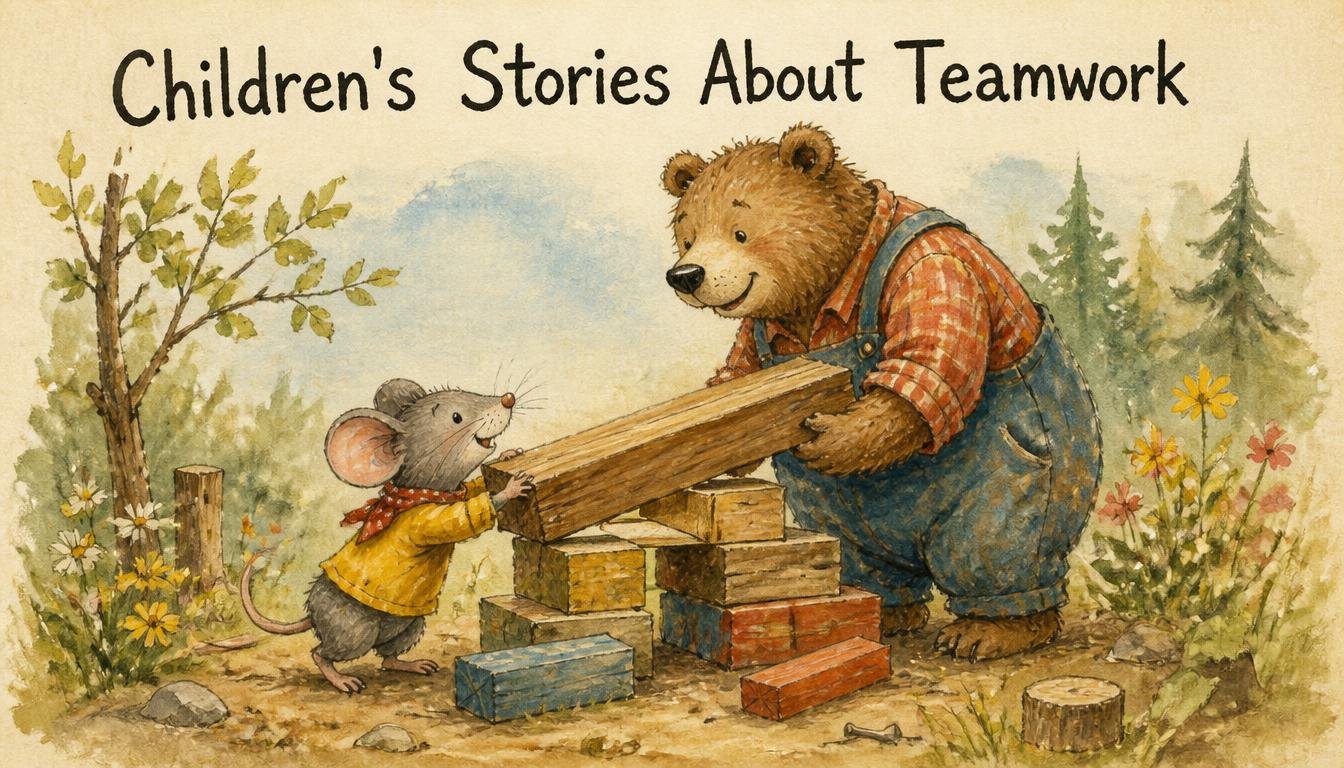
Children’s Stories About Teamwork: Why They Matter and Where to Find the Best Free Ones
Watch a group of kids trying to build something together—a block tower, a sandcastle, or a simple art project—and you see teamwork in its rawest form: equal parts cooperation and chaos. It is not natural to share at first. Or going second. Or hearing someone else’s idea. Or acknowledging that two heads are better than one. This is why teamwork stories for children are so important; they allow children to see what good collaboration looks like in a low-pressure setting, long before they are expected to practice it themselves on a playground or in a classroom.
In this guide, we’ll talk about why stories of teamwork are so valuable to young readers, what makes one really great, and where to find free options worth adding to your family’s reading rotation.
Why Children’s Stories About Teamwork Matter
Teamwork is not an instinct; it is a skill, and like most skills, it helps to see it modeled before being asked to use it.
They show cooperation in action, not just in theory. To say to a child to “work together” is abstract. A story in which two mismatched characters solve a problem by combining their strengths gives kids a concrete, memorable picture of what that actually looks like.
They normalize disagreement as part of the process. The best stories of teamwork do not feature characters that agree on everything from the beginning. Kids watching characters bump heads, negotiate, and succeed together learn that friction isn’t proof that teamwork has failed—it’s often part of how it works.
They build empathy for different strengths. Many stories of teamwork pair characters with very different skills or personalities, the strong one and the clever one, the fast one and the patient one. This helps kids understand that to be able to contribute, they don’t have to be good at the same thing as everyone else.
They prepare kids for real classroom and playground dynamics. Group projects, team games, and shared play all require the very skills these stories subtly model: listening, compromising, and valuing someone else’s idea even if it’s different from your own. Early childhood experts at Zero to Three often highlight these same cooperative skills as an important part of healthy social development.
They make failure feel survivable. Teamwork stories tend to follow the pattern of a setback, a plan that doesn’t work, and a disagreement that slows things down before the characters find their way to success. This helps kids learn that going down together doesn’t have to be the end of the story.
What Makes a Teamwork Story Actually Effective
But a story with multiple characters working together does not always teach the lesson well. A few things make those that really hit the mark.
A real problem that requires more than one skill set. The best teamwork stories are the ones where the problem cannot be solved by any one character, which really drives home the point that collaboration is not just nice but necessary.
Distinct character strengths. Each character brings something different to the table: strength, cleverness, patience, and creativity, and kids get a better sense of how varied contributions make up something bigger than any one piece.
Honest conflict before resolution. A little friction, a disagreement over the plan, and a moment of frustration make the eventual teamwork feel earned instead of automatic. In a story, when everyone agrees instantly, it often feels less realistic and less memorable.
A satisfying, shared success. The best teamwork stories end with a win they all contributed to, not a solution one character could have handled on their own while the rest just watched.
Warmth alongside the lesson. The best teamwork stories allow the message to reside within a truly fun, engaging story, rather than a lecture about sharing in a thin story.
Types of Children’s Stories About Teamwork Worth Exploring
Children’s stories about teamwork come in a few different flavors, and knowing which one fits your child helps you pick the right free book.
1. Mismatched Duo Stories
These often revolve around two very different characters, say a big strong one and a small clever one, who have to use their contrasting strengths to solve a problem. These are particularly effective because they clearly demonstrate that different does not mean less valuable.
2. Group Project Stories
These stories are about a group of multiple characters working toward one common goal, building, solving a puzzle, and preparing for an event, and they are almost exactly like classroom group projects, making it easy to relate directly to kids.
3. Animal Community Stories
Many stories of teamwork involve animals from the same community, a farm, a forest, or an anthill working together for a common purpose. The animal format is a little softer and more playful, which is ideal for younger readers.
4. Reluctant Teammate Stories
These are the words of a character who starts out wanting to work alone or doesn’t think others can be of any help and then finds out that working together gets them further than working alone ever could. This arc really hits home with more independent or strong-willed kids.
5. Sports or Game-Based Teamwork Stories
Team sport or group game stories have an inherent and easily understood teamwork structure; everyone has a role, and success is a function of how well those roles come together.
How to Use Teamwork Stories to Build Real Skills
A good place to start is the book. The lesson is for real life, with a few simple habits.
Pause to highlight each character’s contribution. After a key moment, ask, “What did that character bring to the table that the others couldn’t?” This reinforces the concept of equal importance of different strengths.
Connect the story to a real situation your child is facing. If your child is struggling with a group project or fighting with a sibling, a simple “what about the way they solved it in the book” can make the story seem immediately practical, not just entertaining.
Let your child retell the conflict in their own words. Asking them to say what went wrong before the characters worked it out helps reinforce that disagreement is a normal, expected part of teamwork, not a sign that something has gone badly.
Try a small teamwork activity afterward. A simple two-person puzzle, a collaborative drawing where each person adds something, or a quick cooperative game extends the lesson from the page into hands-on practice.
Revisit favorite teamwork stories before group activities. Reading a familiar story right before a group project, team sport, or playdate can be a gentle, timely reminder of what good collaboration looks like.
A Few Questions Parents Often Ask
My child prefers to work alone. Will teamwork stories actually help?
Yes, often particularly so. Reluctant teammate stories in particular can softly show independent-minded kids the particular benefits of collaborating, without requiring them to change their personality overnight.
At what age should kids start reading stories about teamwork?
Simple stories of two characters helping each other can be good for even toddlers, but the more nuanced lessons, such as on how to handle disagreement, tend to hit home better with preschoolers and early elementary students who are beginning to experience group dynamics more directly.
What if my child relates more to the character who struggles to cooperate than the ones who work well together?
No problem, that’s a good entry point. Highlighting how that character eventually comes around can be more encouraging to a child than just characters who got it right from the jump.
How many teamwork stories should we read to see a difference?
There isn’t a magic number, but it seems to work better with repeated exposure over time rather than a one-time read-through. Having a few teamwork-themed stories in regular rotation makes the lesson stick better than just one reading.
Where to Find Free Children’s Stories About Teamwork
That’s often the hard part for a lot of parents. Good stories of teamwork that don’t come off as preachy but instead feel authentic can be hard to find. It doesn’t always seem practical to build out a themed collection by purchasing books one at a time.
And that’s where a free digital library can help. With a growing library of fun and free picture books, you can find teamwork stories in all sorts of modes, odd couples, group projects, and animal colonies, without having to pay a penny or settle for the first thing you find. If your child needs a little extra push toward cooperation or just loves a good story about friends solving problems together, having free options available means the right book is always within easy reach.
Adapting Teamwork Stories to Different Personalities
Not all kids will respond to the same type of teamwork story, and that’s something to keep in mind as you develop your reading rotation. A naturally social child may be drawn to stories about group projects, enjoying the busy, collaborative energy of several characters working toward a single goal. A more cautious or shy child might identify more with mismatched duo stories where the focus remains on just two characters developing trust with each other at a slower, more manageable pace.
Strong-willed or fiercely independent kids often respond best to reluctant teammate stories, where a character who shares their instinct to go it alone eventually discovers the benefits of collaboration. This tends to land more convincingly than a story where cooperation is simply assumed from page one. Kids who love group activities, sports, games, team projects, etc. tend to enjoy seeing that enthusiasm mirrored directly into sports or game-based teamwork stories.
You don’t need to choose a single style. In contrast, reading the same kind of story over and over tends to give kids a more rigid, less well-rounded understanding of teamwork. It’s better to rotate through a few different kinds over time so kids can see multiple models of what teamwork can look like.
Final Thoughts
When kids read stories about teamwork, they get to see cooperation, conflict, and eventual success played out safely on the page, long before they’re required to navigate those same dynamics themselves. That silent rehearsal tends to matter way more than any direct lesson about sharing or working together ever could.
Get one free teamwork story this week. See where your child lights up the most, the mismatched strengths, the disagreement, and the shared win, and let that guide which story you reach for next. Over time, these stories shape not only what kids read but also how they actually show up the next time they are asked to work with someone else.
Want more free, fun stories to help build important life skills? See our full Kids Library for picture books about teamwork, friendship, and more.